Fun Fact

There's a NASA Instrument Named LEISA

A near-infrared spectrometer flying through the outer solar system shares more than a name with Leisa Coffman.

Leisa has identified with the universe since she was a child, following NASA missions long before it was something she'd ever build a website about. In the early 2000s, she learned that NASA had built and flown an instrument called LEISA — short for Linear Etalon Imaging Spectral Array.

The kinship was immediate. In her own research, Leisa analyzes different data to identify information that gets missed by most people looking at the same material. LEISA does something strikingly similar — it examines light from distant worlds to identify substances hidden in plain sight. She reached out to NASA directly to learn more. They responded promptly, and graciously.


Where It Started

LEISA & New Horizons

LEISA's technology was originally developed in the early 1990s by Drs. Donald Jennings and Dennis Reuter at NASA's Goddard Space Flight Center — an ultra-lightweight spectrometer design submitted to a NASA "Advanced Technology Insertion" competition seeking advanced instruments for future outer solar system missions.

Paired with a visible-light camera called MVIC, LEISA became part of a combined instrument named Ralph — a nod to Ralph Kramden of The Honeymooners, flown alongside a UV spectrometer named Alice. Together they packed onto NASA's New Horizons spacecraft, launched in 2006 on a decade-long journey to Pluto.

The entire Ralph instrument weighed about 23 pounds and ran on just over 7 watts of peak power — less than a household lightbulb — at a time when scientists could still only guess what Pluto was made of.

When New Horizons flew past Pluto in 2015, LEISA was one of the instruments that finally let scientists map the ices, rocks, and organic compounds on its surface. Jennings and Reuter's work later earned the team a Samuel J. Heyman Service to America Medal.
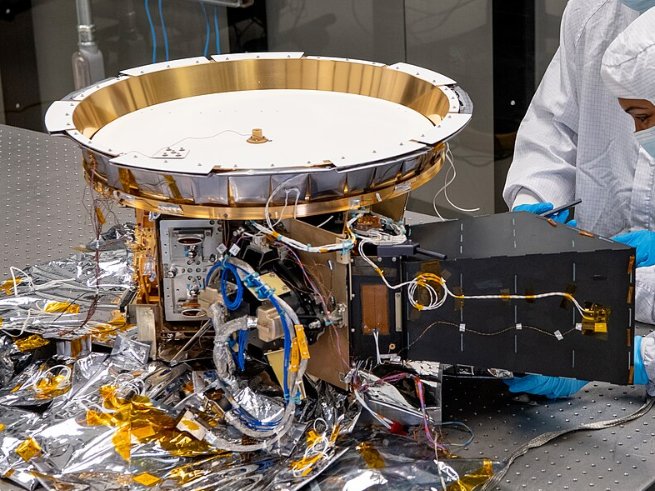
Ralph/LEISA-family hardware during assembly at NASA

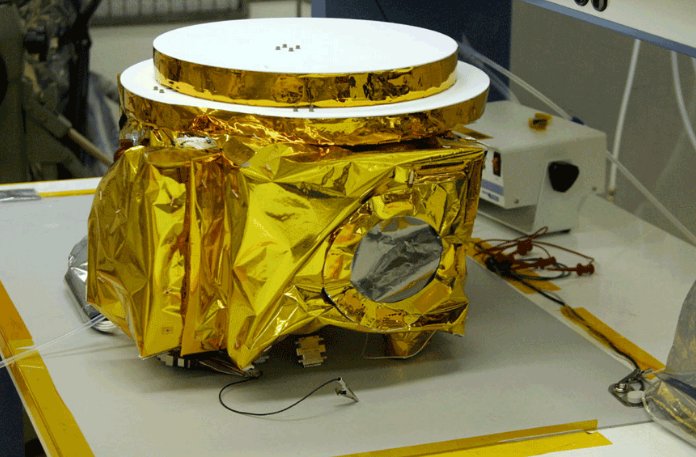
A Ralph/LEISA-family instrument wrapped in gold thermal insulation
Where It's Flying Now

LEISA Today — On Its Way to the Trojan Asteroids

LEISA's story didn't end at Pluto. An upgraded version of the same technology now flies aboard L'Ralph, an instrument on NASA's Lucy mission — launched in 2021 and currently en route to Jupiter's Trojan asteroids, a swarm of ancient bodies left over from the solar system's formation.

Inside L'Ralph, a shared telescope gathers light and splits it at a beam splitter: visible light reflects toward the MVIC camera, while infrared light passes through a linear variable filter directly onto LEISA's detector array.

This newer LEISA contains an etalon — a pair of thin reflective surfaces that separate light into a spectrum, much like a prism. By analyzing how different substances on an asteroid's surface absorb and emit different wavelengths, it can identify the rocks, ices, and organic compounds present. Its detector holds 1,400 rows of 1,000 pixels each, with every row tuned to a different infrared wavelength — precise enough to resolve craters as small as 500 meters wide from 1,000 kilometers away.

LEISA and Ralph aren't retired instruments sitting in a museum — they're still actively at work. Lucy's most recent close encounter came on April 20, 2025, when the spacecraft flew within 596 miles of the asteroid Donaldjohanson, with L'Ralph — MVIC and LEISA together — actively observing throughout. Lucy isn't due to reach its first Jupiter Trojan asteroid until 2027, but the same idea Leisa felt a kinship with more than two decades ago is still out there right now, doing exactly what it always did — finding what everyone else missed.


Sources: NASA Goddard Space Flight Center; Johns Hopkins Applied Physics Laboratory (New Horizons); NASA Science — Lucy Mission; Southwest Research Institute (L'Ralph instrument); Service to America Medals.


← Back to About Leisa