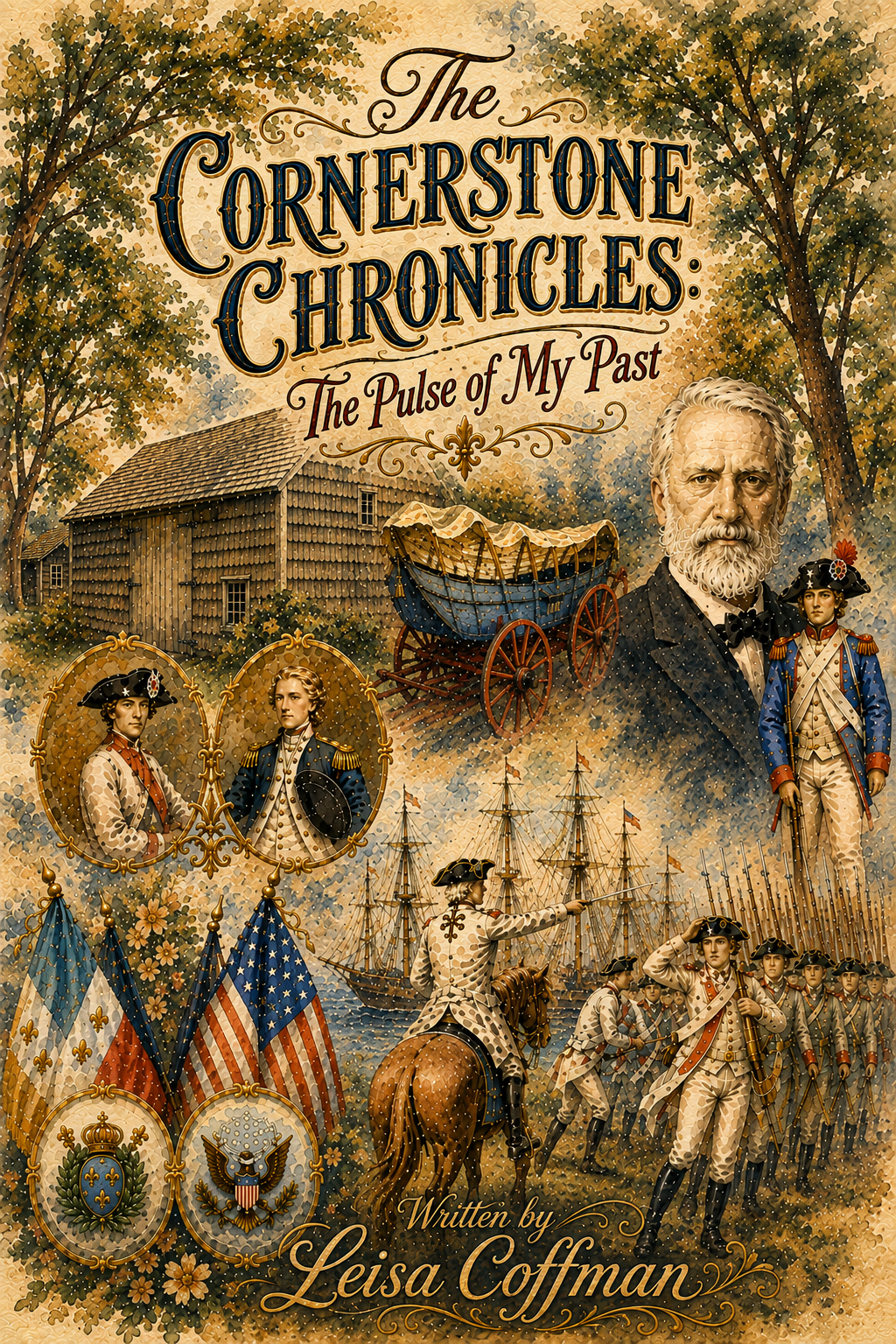
Echoes From My Past — a documentary tracing an unbroken chain of foundational American history, woven directly into one family's bloodline.
Genealogy OddsThis is a story about meaningful coincidences — history finding you when you least expect it, and a spiritual instinct that turns out to have been right all along.
Long before any document confirmed it, I recognized a stranger's face in a 19th-century photograph as my father's. I felt an unexplainable pull toward someone, a sense of knowing them, sharing their birthday, watching their films for as long as I can remember. Then synchronized events led me to realize how we are connected in more ways than we can fathom.
None of this was passed-down family history. My own history is my family's history too — and every one of them has been just as shocked by each discovery as I was.
The names in this story happen to be remarkable. Founders. Publishers. But the names aren't the point. The point is that something in me knew, before I had any proof — and what I trusted by instinct turned out to be true.
When a filmmaker digs into her own genealogy, she uncovers an unbroken chain of foundational American history — a soldier who walked beside George Washington, a lost land patent, a publishing empire, and a childhood neighbor who turns out to be family — revealing that the birth of a nation is a living pulse in her own veins.
Every nation has its founding myths, but few family trees hold the literal receipts of how America was built. The Cornerstone Chronicles: Echoes From My Past traces one exceptionally rare lineage woven directly into the fabric of the United States: a soldier who walked beside George Washington, a 1640 land patent that founded a town still standing today, a Smithsonian-validated pioneer wagon, a publishing empire built by a cousin six generations removed — and a childhood neighbor who, after a lifetime of unexplained synchronicities with a Hollywood icon, turns out to be family in his own right.
This isn't just a history lesson — it is a prestige, visual journey proving the past isn't dead. It beats inside us.
This structural layout organizes one family's rare heritage into six distinct, high-impact documentary chapters.
Concept: The creative lens of the filmmaker connecting to the bloodline.
Visuals: Modern-day footage transitioning into archival ink, museum artifacts, and historical landscapes.
Core Theme: How deep national history beats inside a personal, modern life.
Subject: The filmmaker's 4x great-grandfather, Charles Dequasie.
Narrative: His service in the French army, his voyage across the ocean, and his firsthand account of walking alongside America's founding forefathers during the birth of the nation. The filmmaker travels to Paris, France for research, to uncover unknown French family history.
A soldier's firsthand account of walking beside the founders of a nation that wasn't yet his own.
Subject: The filmmaker's 9th great-grandfather, Thomas Sayre, a 1640 founder of Southampton.
Narrative: The deep ancestral roots of the Sayre lineage on Long Island — the early land patents, the building of the historic Sayre house, and the foundation of early American communities. The filmmaker visits the actual barn of her great-grandfather, on display at the Southampton Museum.
An arrest that, against all odds, led directly to the founding of an American town.
Subject: The filmmaker's childhood neighbor, Stella — who was like a grandmother to her — and her late husband, Jacob.
Narrative: Grounded in the filmmaker's childhood memories growing up in Sandyville, West Virginia, beside Stella, until her passing in 1975 when the filmmaker was 12. Alongside those memories sits a lifelong, unexplained kinship with an iconic actress — a shared birthday, years spent watching her films — that resurfaces decades later when a YouTube suggestion, unprompted, leads the filmmaker to Out on a Limb, a film she'd oddly never heard of, based on the actress's own memoir. Watching it, she recognizes her own 2003 life-changing experience mirrored in a story from the 1980s — down to the very phrase that gave the book its title, the same phrase behind a Teena Marie song the filmmaker played several times daily, drawn to it without knowing why. Researching the song later, she discovers Teena Marie wrote it after reading that same memoir. The synchronicity brings back a memory: Stella carried the same last name as the actress, through her late husband, Jacob. Following that feeling into a genealogy search, the filmmaker discovers she herself is related to Jacob — and that the actress is too. It's a reminder that the people we're drawn to are often already connected to us, in ways we can't yet explain.
A lifelong kinship toward a stranger on a movie screen — that led her straight back to family she never knew she had, right next door.
Subject: The filmmaker's 5x great-grandfather, Isaac Coffman (Kauffman).
Narrative: Following the family's westward migration into West Virginia. Features his rare, restored Winchester Valley covered wagon at the Greenbrier Historical Society and North House Museum in Lewisburg, and introduces the theme of names blurring and changing on the frontier — Kauffman to Coffman. The filmmaker visits the museum to see the actual wagon that belonged to her 5x great-grandfather.
The Winchester Virginia Valley Wagon — the finest surviving example in the country, validated and restored by a former Smithsonian assistant curator, Donald Birkebile: 90% original wood, 95% original iron, 100% original running gear.
Subject: The filmmaker's biological and spiritual cousin, Isaac Kauffman Funk, co-founder of Funk & Wagnalls.
Narrative: Building on the cosmic themes of Chapter Three, this episode explores how the filmmaker's own professional publishing background, deep love of text, and filmmaking journey perfectly mirror the life and legacy of her ancestral cousin. The filmmaker visits the actual mansion that belonged to her cousin, located in New York City — still standing and occupied today.
Co-founding the prestigious Funk & Wagnalls publishing empire — capturing the power of the printed word and encyclopedic preservation.
Subject: The filmmaker's 3x maternal grandfather, George Shamblin, and 3x fraternal grandfather, Squire John Quinn.
Narrative: The grand finale, exploring the rugged branches of West Virginia. It covers the devastating toll of the Civil War at Shamblin's Ridge, the brothers who broke away to fight for the Union, and the civic legacy of Squire John Quinn along the New River. The filmmaker, with a guide and metal detecting experts, hikes the very mountains in search of Civil War and other historic artifacts, and locates the family cemeteries still there.
One family ridge fell to ashes in the Civil War. Another branch, born of the same rebellion, built a legacy that still stands along the New River.
For a writer, history has never been a collection of dead facts filed away in silent town registries. It is a living, breathing force — the invisible architect of our personalities, our talents, our choices. We like to believe we are the sole authors of our lives, unaware that the plots we're writing were outlined centuries ago by the people who carried our names. The Pulse of America is not a standard historical documentary. It is an intimate, cinematic investigation into genetic memory, material culture, and the astronomical probabilities of a single bloodline. For over twenty years, I worked alongside a best-selling author and a publisher, honing a lifelong dedication to the written word. I believed this career path was a purely individual choice. Then, in the fall of 2024, history staged an intervention. Hosting a film festival inside the Wagnalls Memorial Library in Lithopolis, Ohio, I stopped in front of a document bearing my family name — Isaac Kauffman Funk, the Gilded Age tycoon who built the Funk & Wagnalls printing empire. What caught my breath was his face: the unmistakable bone structure and eyes of my father, my uncles, even myself. Forensic genealogy confirmed it. He was my cousin. That same instinct struck twice. For years, I'd felt an unexplainable pull toward an actress I admired — a shared birthday, a lifetime of watching her films — long before I discovered why. My childhood neighbor Stella, a woman who was like a grandmother to me, had married a man named Jacob Beaty. A genealogy search meant only to check on that synchronicity turned up something I hadn't expected: Jacob was family, a fellow descendant of the same Sayre line I trace my own roots through. Two people I loved without knowing why — one connected to me by an unexplainable feeling, the other by blood I never knew I had. From a French soldier who crossed the Atlantic twice to fight in the Revolution, to Puritan founders defying empires under a 1640 land patent, to a Smithsonian-restored pioneer wagon rolling across the frontier — the receipts of my lineage were everywhere. And when the timeline fractures into conflict, the pulse beats loudest: from a family ridge burned in the Civil War, to my grandfather in the trenches of World War I, to my own father carrying that mantle into World War II. As a filmmaker and a writer, I am uniquely positioned to helm this six-part docuseries — with first-hand access to the artifacts, the archives, and the landmarks that anchor each hour. The Pulse of America will prove that the past isn't dead. It is riding shotgun in our blood, waiting for us to notice it.